

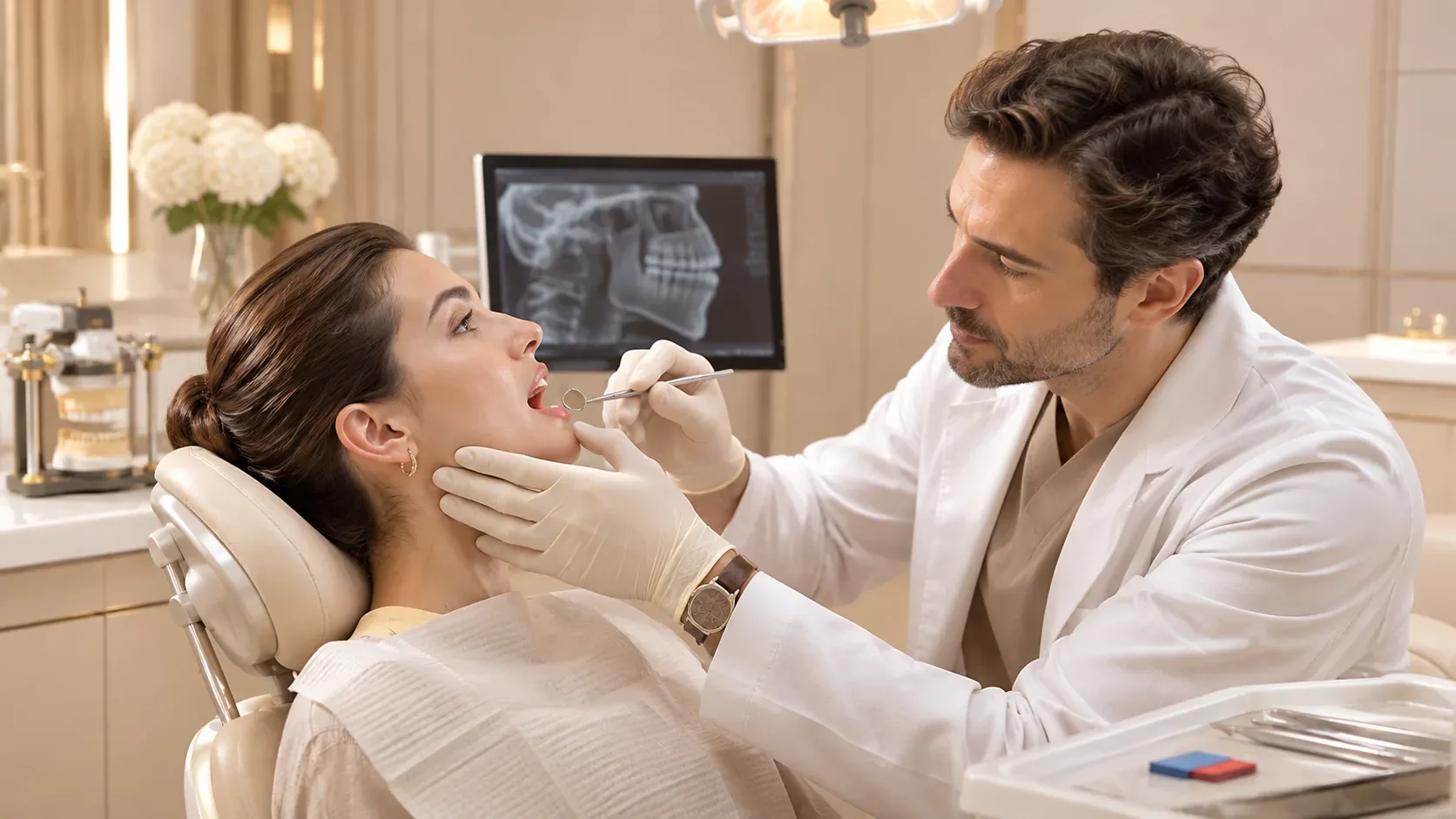
Gnathology in Tbilisi
Restore comfort, function, and balance with professional gnathological diagnostics and treatment at Richter’s Clinic in Tbilisi. We assess the relationship between your teeth, bite, jaw joints, and muscles to identify the underlying causes of functional problems and create an individual treatment plan.
At Richter’s Clinic, gnathology is an important part of comprehensive dental diagnostics. Rather than evaluating teeth individually, a gnathological examination considers the entire functional system: teeth, occlusion (bite), temporomandibular joints (TMJ), chewing muscles, and jaw movements.
This approach can be particularly valuable before orthodontic, prosthetic, restorative, or complex full-mouth treatment, as well as for patients experiencing jaw discomfort or functional symptoms.
What is Gnathology?
Gnathology is the field of dentistry concerned with the function and interaction of the teeth, jaws, temporomandibular joints, and masticatory muscles.
A gnathological assessment helps the dentist understand how the upper and lower jaws meet, how the jaw moves during speaking and chewing, and whether the bite is placing excessive or uneven stress on the teeth, muscles, or joints.
The purpose is not simply to change the bite, but to identify functional abnormalities and determine whether treatment is necessary.
When Should You See a Gnathologist?
A gnathological consultation may be recommended if you experience:
- Jaw pain or discomfort
- Clicking, popping, or other sounds in the jaw joint
- Difficulty or discomfort when opening the mouth
- Limited jaw movement
- Muscle tension around the jaw or face
- Tooth wear, chipping, or fractures
- Teeth grinding or clenching
- An uncomfortable or unstable bite
- Frequent changes in how your teeth seem to meet
- Discomfort when chewing
- Problems associated with previous dental restorations
- The need for extensive prosthetic or orthodontic treatment
Not every clicking jaw or irregular bite requires treatment. Proper diagnosis is essential before deciding whether intervention is necessary.
Gnathological Diagnostics at Richter’s Clinic
A gnathological examination begins with a detailed assessment of the patient’s symptoms, dental history, bite, jaw movements, muscles, and temporomandibular joints.
Depending on the individual case, diagnostics may include:
- Clinical Examination
Assessment of the teeth, bite, jaw position, muscles, and temporomandibular joints. - Digital Intraoral Scanning
Precise digital impressions allow us to analyse the position and relationship of the teeth without conventional impression materials. - Occlusal Analysis
Evaluation of how the upper and lower teeth contact during biting and jaw movements. - Jaw Relationship Assessment
In complex cases, the relationship between the upper and lower jaws may be recorded and analysed in a reproducible position. - Articulator Analysis
Dental models or digital data may be transferred to an articulator to reproduce jaw relationships and analyse occlusion outside the mouth. - 3D Diagnostics
When clinically indicated, CBCT imaging may be used to evaluate anatomical structures and support comprehensive treatment planning.
The exact diagnostic protocol depends on the patient’s symptoms and the complexity of the case.
Gnathology and TMJ Disorders
The temporomandibular joints connect the lower jaw to the skull and are involved every time we speak, chew, or open the mouth.
TMJ-related symptoms may have different causes and can involve the joints themselves, the surrounding muscles, the bite, parafunctional habits such as clenching or grinding, or a combination of factors.
For this reason, treatment should begin with diagnosis rather than assuming that every TMJ symptom is caused by the bite.
Gnathology Before Orthodontic Treatment
Gnathological diagnostics can be especially useful in complex orthodontic cases.
Before changing the position of the teeth, the doctor may evaluate jaw movements, joint function, muscle condition, and occlusion. This provides additional information for treatment planning and can help establish a more functionally balanced final result.
At Richter’s Clinic, gnathological principles can be integrated into both braces and clear aligner treatment when clinically appropriate.
Gnathology Before Veneers, Crowns, and Full-Mouth Rehabilitation
When several teeth are being restored, even small changes in tooth shape and height can influence the way the upper and lower jaws interact.
For extensive treatment involving veneers, crowns, bridges, implants, or full-mouth rehabilitation, gnathological analysis can help determine an appropriate bite relationship before the final restorations are manufactured.
This allows the restorative plan to consider not only aesthetics, but also function.
Treatment Options
Gnathological treatment is always based on the diagnosis. Depending on the individual case, treatment may involve:
- Observation and periodic monitoring
- Behavioural recommendations
- Management of clenching or grinding habits
- Occlusal splints
- Physiotherapy or multidisciplinary management
- Orthodontic treatment
- Restorative or prosthetic treatment
- Correction or replacement of problematic restorations
- Comprehensive bite rehabilitation
There is no single treatment that is appropriate for every patient with jaw symptoms.
Book a Gnathology Consultation in Tbilisi
If you experience jaw discomfort, clicking, tooth wear, bite instability, teeth grinding, or are planning complex orthodontic or prosthetic treatment, a gnathological consultation can provide a more complete understanding of your dental function.
At Richter’s Clinic in Tbilisi, we combine clinical examination with modern digital diagnostics to create an individual, function-oriented treatment plan.
Questions & answers
Frequently Asked Questions
A general dentist treats diseases and conditions affecting the teeth and oral cavity. A dentist working with gnathology focuses additionally on the functional relationship between the teeth, bite, jaw joints, chewing muscles, and jaw movements.
TMJ stands for temporomandibular joint. There is one joint on each side of the jaw, connecting the mandible to the skull. Problems involving these joints and associated structures are commonly referred to as temporomandibular disorders, or TMD.
Not necessarily. Jaw clicking is relatively common and does not automatically mean that treatment is required. It should be assessed if it is accompanied by pain, locking, restricted movement, progressive changes, or other symptoms.
Gnathological assessment can help evaluate the effects of bruxism or clenching on the teeth, muscles, joints, and existing restorations. Depending on the case, management may include an occlusal splint and other measures.
Not for every single restoration. However, it can be valuable before extensive prosthetic treatment, significant changes to the bite, full-mouth rehabilitation, or treatment of patients who already have functional symptoms.
Jaw-muscle tension and temporomandibular disorders can be associated with certain types of facial or temporal pain, but headaches have many possible causes. A gnathological assessment can determine whether the masticatory system may be contributing to the symptoms.
The duration depends on the complexity of the case and the diagnostic procedures required. After the initial examination, the doctor will determine whether additional scans, records, or functional analysis are necessary.
Dental Clinic & Facial Aesthetics in Tbilisi